


Project Overview
Secret of Pamola features custom 3D printed escape room puzzles designed by “got a Quest” company and brought to life by OrangeCube3D for at-home kids’ birthday parties.
Ever wanted to bring an at-home escape room to your living room—without the venue hassle, logistics, or price tag? That’s exactly what one US-based client set out to do with the Secret of Pamola project: immersive, electronics-driven escape room experiences for kids’ birthday parties, right at home.
OrangeCube3D was tasked with translating this vision into reality. The challenge: design robust, easy-to-assemble custom 3D printed puzzle enclosures for a set of electronic games. The requirements? Support-free FDM printing, precise fit for custom PCBs and sensors, robust electronics housing, and tool-free assembly for non-technical users. The result: a portfolio of support-free FDM enclosures engineered for real-world use and reliability.
Puzzle Highlights: Secret of Pamola At-Home Escape Room
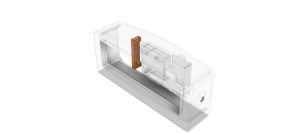
Security Puzzle
Built around a PIR (Passive Infrared) sensor, the Security Puzzle detects movement and triggers a fail state if players aren’t stealthy enough. The enclosure needed to be rugged, easy to assemble, and protect sensitive electronics from both shipping and party chaos.
Referenced images:

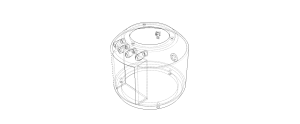


Design notes:
- Detachable orange lid for quick access and secure closure.
- All mounting points and cutouts engineered for precise, support-free fit.
- Internal electronics holder keeps components locked down and protected.
Green Segment Display Puzzle
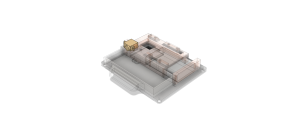
This puzzle uses a custom numeric display—random segments flash, and players have to decode a hidden message. The enclosure had to fit the custom PCB and display perfectly, be rugged enough for repeated use, and print support-free.
Referenced images:
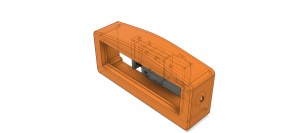
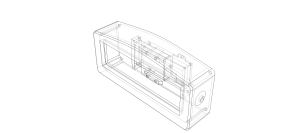
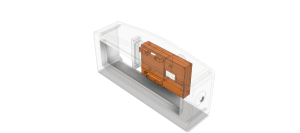
Design notes:
- Orange outer case and internal holders engineered for precise fit and shock resistance.
- Every mounting point modeled to spec and validated in real-world prints.
- Support-free FDM enclosure—no post-processing, just print, assemble, and play.
Pedestal Puzzle
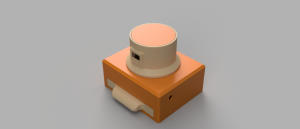
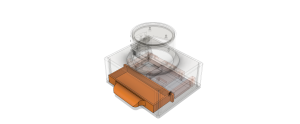
The Pedestal Puzzle acts as a scale: place the correct object on top, and a hidden drawer unlocks. Mechanically, this required integrating a load cell, servo motor, and robust drawer system—all inside a child-proof, support-free enclosure.
Referenced images:
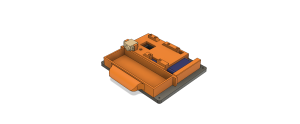
Design notes:
- Orange drawer unlocks only when the load cell detects the correct weight.
- Internal holders keep electronics and servo secure, with everything accessible for maintenance.
- Engineered to withstand repeated use and rough handling by kids.
Collaboration & Process
- Client provided: Technical docs, PCB dimensions, wiring diagrams, and rough sketches.
- OrangeCube3D handled: CAD modeling, print file prep, and all design iterations.
- Workflow:
- Review requirements and datasheets
- Model enclosure in CAD, focusing on support-free FDM enclosure geometry and robust assembly
- Export print-ready files
- Remote feedback loop: client printed prototypes in the US, tested fit and function, sent feedback
- Revise and repeat until every part fit perfectly and assembly was foolproof
Remote collaboration meant fast iteration cycles and blunt, real-time feedback—no sugarcoating, just making things work. For more on our approach, see our Batch Production workflow.
Challenges & Solutions
- Support-Free FDM Enclosure: Every part was engineered for FDM printing with zero supports, reducing print time and eliminating post-processing headaches for the client. See our blog on support-free design for more details.
- Robust Electronics Housing: Tight tolerances for PCBs, displays, and sensors—modeled to spec, then verified by the client’s real-world test prints.
- Durability: Enclosures had to survive shipping and the abuse of actual children’s parties. Thick walls, robust joints, and smart geometry did the trick.
- Assembly for Non-Techs: All designs prioritized intuitive, tool-free assembly. If a parent couldn’t snap it together in five minutes, it went back to the drawing board.
Results & Learnings
The Secret of Pamola custom 3D printed puzzles were successfully used in home-based escape room parties, rented out for kids’ birthdays and special events.
What OrangeCube3D gained:
- Sharper skills in technical modeling for electronics
- A streamlined, feedback-driven remote workflow
- More confidence tackling complex, multi-part puzzle projects
Ultimately, while the puzzles themselves held up well, the business faced challenges that went beyond 3D-printed parts. High shipping costs and the wear and tear on other equipment—like paper-based puzzles and supporting materials—made it tough to sustain the rental model at scale. It’s a classic hardware lesson: even the best-engineered components can be let down by logistics and the realities of repeated use in the field.
Related Services
Interested in custom puzzle design service, batch production, or technical modeling for electronics?
Check out our other project case studies for more examples of technical, artistic, and problem-solving work.
FAQ
Can these puzzles be customized for other themes or party types?
Absolutely. OrangeCube3D specializes in custom 3D printed enclosures for a wide range of escape room and puzzle applications.
What materials are used for the puzzle enclosures?
All enclosures are printed using high-quality FDM filaments, engineered for durability and safety in home environments.
Are these puzzles suitable for repeated rental use?
Yes. Each enclosure is designed for robust, repeated handling and easy maintenance.
Client Testimonial
“The puzzles were a huge hit with the kids—sturdy, clever, and easy to set up. OrangeCube3D made the whole process painless.”
– US-based client